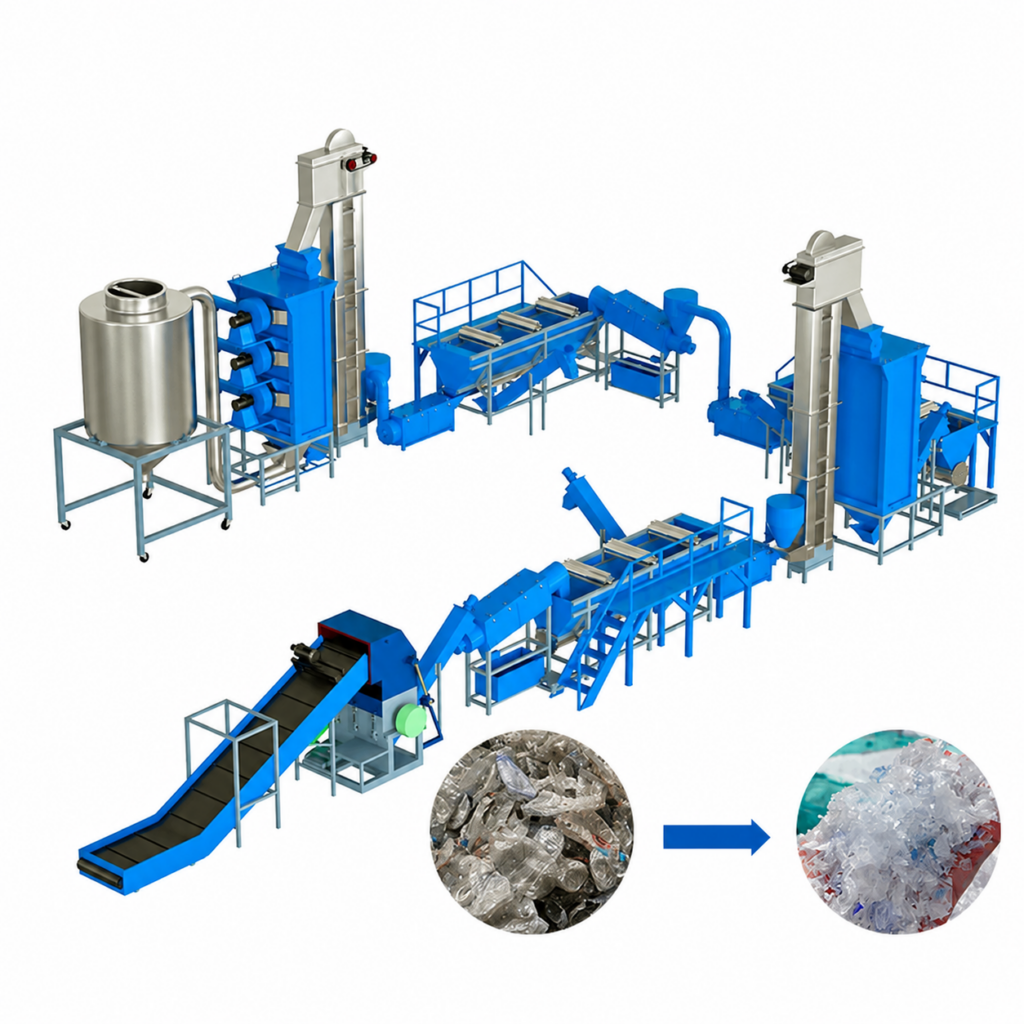
A PET bottle recycling line converts sorted post-consumer beverage bottles into clean PET flakes and, when extrusion is included, recycled PET pellets. The process must remove labels, caps, adhesives, residual liquids, metals, PVC and other contaminants while controlling moisture and protecting the material’s intrinsic viscosity.
Sanxing Machine develops PET recycling systems around the incoming bottle stream and the customer’s final application. A line producing flakes for fiber has different quality priorities from a project targeting sheet, strapping or bottle-to-bottle rPET. This guide explains the full workflow and the decisions that determine a practical configuration.
PET recycling outputs: flakes or pellets
A washing line can finish with clean, dry PET flakes. These flakes may be sold or used directly in suitable downstream processes. When an extrusion and pelletizing section is added, the flakes are dried, melted, filtered, degassed and cut into pellets for more consistent handling and processing.
For demanding food-contact or bottle-to-bottle applications, additional decontamination, traceability, quality-control and solid-state polycondensation may be required. Final compliance depends on the complete validated recycling process, controlled feedstock, operating records, testing and the regulations of the destination market.
Typical raw materials
- Sorted post-consumer PET beverage bottles
- Compressed PET bottle bales
- Suitable food-contact PET packaging streams
- Pre-crushed PET bottle flakes
- Clear, light-blue or controlled-color PET streams
PVC bottles, multilayer packaging, opaque PET, excessive labels and mixed polymers require careful sorting. Even small quantities of incompatible material can affect rPET quality, so the sorting strategy is a central part of the plant design.
Complete PET bottle recycling process
1. Bale opening and bottle feeding
Compressed bales are opened and bottles are metered into the line. Controlled feeding prevents overload and gives the sorting equipment a more consistent material layer.
2. Pre-sorting and metal removal
Manual or automatic sorting removes non-PET containers, colored bottles and foreign materials. Metal detectors or separators protect crushing equipment. The automation level depends on labor availability, incoming quality and final purity requirements.
3. Label removal and pre-cleaning
A label remover separates a large proportion of sleeves and labels before crushing. Dry pre-cleaning can remove loose dirt and lightweight contamination, reducing the load on the water system.
4. Wet crushing
Bottles are cut into controlled-size flakes. Water introduced during crushing starts cleaning the material and reduces dust. Blade design, screen size and wear protection are selected according to bottle condition and capacity.
5. Sink-float separation
PET sinks in water, while many PE and PP caps and label materials float. Density separation therefore removes a significant part of the polyolefin contamination. Tank design and material residence time affect separation efficiency.
6. Hot washing and friction washing
Hot washing loosens adhesives, oils and organic residues. Friction washing scrubs the flake surface and separates remaining contamination. Temperature, chemical dosing and residence time must be controlled to achieve the target cleanliness without unnecessary resource use.
7. Rinsing, dewatering and drying
Multiple rinsing stages remove loosened contamination and washing chemicals. Centrifugal dewatering and thermal drying reduce moisture before storage or extrusion. PET is sensitive to hydrolytic degradation, so moisture control becomes especially important before melt processing.
8. Flake sorting and quality control
Optical or color sorting can remove remaining colored flakes, PVC and other defects. The need for automatic sorting depends on the incoming bottle stream and the target product specification.
9. Crystallization, drying and extrusion
For pellet production, PET flakes are prepared under controlled drying conditions before entering the extruder. The melt is homogenized, vacuum degassed and filtered to remove fine solid contamination.
10. Pelletizing and optional SSP
The filtered PET melt is cut into pellets and cooled. Solid-state polycondensation can be added when the project requires further decontamination or intrinsic-viscosity recovery and enhancement. SSP selection should be based on the final application and validation plan.
Key quality indicators for recycled PET
Buyers and processors may evaluate moisture, PVC content, polyolefin content, color, black specks, dust, metal, adhesive residue and intrinsic viscosity. There is no single output specification suitable for every application. The required limits should be defined before the equipment configuration is finalized.
Representative feedstock sampling is equally important. A line cannot compensate for uncontrolled incoming material without adequate sorting and process design.
Capacity, utilities and factory layout
Line capacity depends on bottle composition, contamination, automation and final quality. Project planning should cover installed power, operating load, fresh and recycled water, steam or thermal energy, compressed air, wastewater treatment, floor area and storage.
A logical layout reduces unnecessary conveying and provides access for blade changes, screen cleaning and preventive maintenance. Sanxing can prepare an equipment arrangement after receiving workshop dimensions and material-flow requirements.
Choosing between a washing line and a washing-pelletizing line
Select a washing line when clean PET flakes are the intended saleable product or will feed an existing extrusion system. Select an integrated washing and pelletizing solution when the project requires rPET pellets and coordinated control from bottle preparation through melt filtration.
View the Sanxing PET Bottle Washing Line or explore the plastic washing line category for the current product framework.
Information needed for a project proposal
- Photos, video and origin of the PET bottles
- Bale composition and color distribution
- Known PVC, label, cap and contamination levels
- Required input capacity and usable output
- Target flake or pellet specification
- Final rPET application and destination market
- Available workshop size and utilities
- Required sorting and automation level
Frequently asked questions
Can one line produce both PET flakes and pellets?
Yes. The washing section can produce clean flakes, and an integrated or downstream extrusion section can convert suitable flakes into pellets.
Does the line automatically guarantee food-grade rPET?
No. Food-contact suitability depends on the complete validated process, feedstock controls, operating conditions, testing and regulatory approval—not on one machine or marketing description.
Why is PVC removal important?
PVC can degrade at PET processing temperatures and negatively affect color and product quality. Sorting and quality control should therefore minimize PVC before extrusion.
How can I obtain a customized layout and quotation?
Contact Lisa through the Sanxing inquiry page with material photos, capacity, final product and factory information. We will prepare a project-specific recommendation.
Quality assurance and production records
A PET recycling plant benefits from a sampling plan at several points: incoming bottles, washed flakes, dried flakes and final pellets. Checking only the finished product makes it difficult to identify where contamination entered or where quality changed. Depending on the target application, routine tests may include moisture, PVC, polyolefins, color, fines, metal, black specks and intrinsic viscosity.
Operators should also record washing temperature, chemical concentration, drying condition, melt pressure, vacuum level and filtration changes. These records help distinguish a feedstock problem from an equipment or operating problem. Retained samples from each production batch provide a practical reference when discussing quality with customers.
Preventive maintenance is especially important around label removal, crusher knives, separation tanks, dryer screens, vacuum systems and melt filters. Worn or blocked components can reduce purity before a visible machine failure occurs. A planned spare-parts list, documented cleaning procedure and regular inspection schedule support stable output and reduce unexpected downtime.